

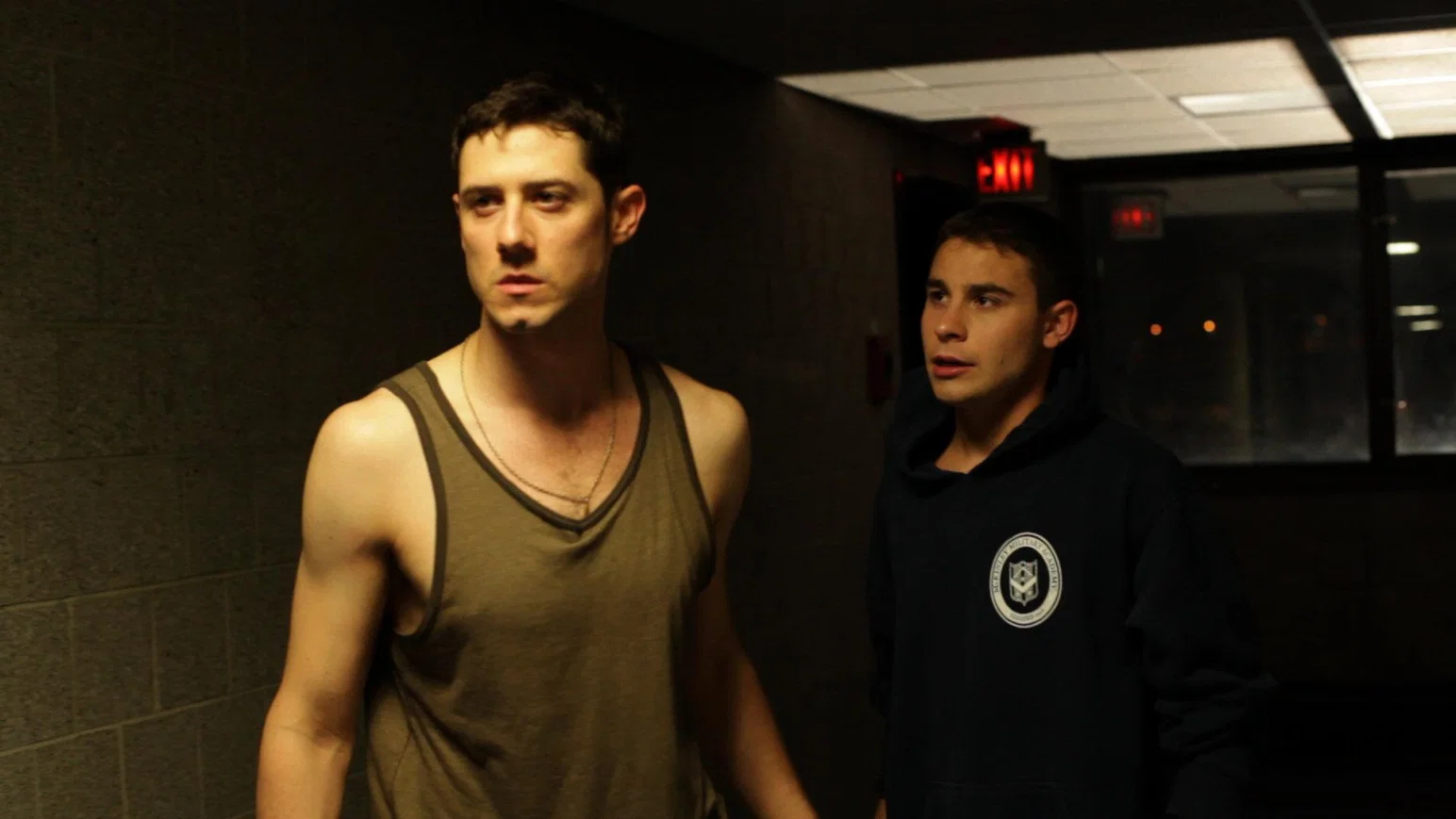
“When Bush was re-elected in 2004, I felt like a lot of people I knew were depressed and felt we were powerless,” director Alan Brown once remarked about the man who’d continually pledged his support for the LGBTQ+-stifling military policy known as Don’t Ask, Don’t Tell. “I asked myself, ‘How can I contribute as a filmmaker to this issue?’” Seven years later, the answer proved to be: give Romeo And Juliet a queer spin and set it at a modern-day cadet school.
After tackling the subjects of gay hate crime in his chapter of anthology Boys Life 4 (“O Beautiful”) and Iraq War PTSD in the feature-length Superheroes, Brown had been inspired to make his distinctive protest after watching stage play Shakespeare’s R&J, a similarly subversive retelling set at a strict boys’ prep school. But while the latter’s sexual tension never strayed beyond the homoerotic—in fact, its cast remained buttoned-up at all times —Private Romeo allows its oft-shirtless characters to fully act on their physical impulses.
Released 15 years ago this month, Brown’s tale opens in an English lit class, where eight young men—forced to stay on campus after failing to qualify for a four-day land navigation exercise—are studying the story of the world’s most famous star-crossed lovers.
And without any faculty members to keep them in check (a plot device which also helped with the incredibly low budget) the text is initially greeted with indifference and then schoolboy snickering at lines such as “I am too sore pierced with his shaft to soar with his light feathers” and “For the bawdy hand of the dial is now upon the prick.” However, the group eventually falls under the Bard’s spell, and pretty soon, their real lives start to mirror its prose.
Sam (Seth Numrich) and Glenn (Matt Doyle), channeling their inner Romeo and Juliet, begin to develop intense feelings for each other, while Josh (Hale Appleman) takes on the duplicitous persona of Mercutio. A vast majority of the dialogue is lifted verbatim from the classic text, only blurring the boundaries between reality and fantasy even further. There’s even a recreation of the balcony scene, although here “Juliet” pines for his love in a classroom.
The film continues to cleverly utilize its military academy location (SUNY Maritime College in the Bronx), particularly the basketball court which stages the lovebirds’ meet-cute and Marcutio & Tybalt’s (represented here by Bobby Moreno’s Carlos) fight to the death. Of course, in the change most likely to leave Shakespeare purists clutching their pearls, no one actually dies here. Even ‘Romeo’ and ‘Juliet’ manage to make it to the end with their lives intact, Brown unwilling to bury his gays even when adapting the tragedy of a double suicide.
Private Romeo also strays from the source material when ‘Juliet’ is awoken in the middle of the night, strapped to a chair and gagged by duct tape, a sequence shot in the style of an indie-rock promo. Furthermore, the cadets spend their downtime lip-syncing to songs on YouTube and the whole thing concludes with Doyle performing early 20th century standard “You Made Me Love You (I Didn’t Want to Do It)” straight down the camera, a detour into high camp which sits at odds with a film that otherwise plays it relatively straight, no pun intended.

Whether you believe Private Romeo to be a brilliantly radical take on a love story that’s been told countless times before or an act of cultural sacrilege, it’s hard to deny the performances are uniformly excellent. Doyle, a future Tony Award winner for his turn in Company, and Numrich, the youngest actor ever accepted into Juilliard, share a palpable chemistry as they navigate the complexities of both Shakespeare’s words and their own sexualities. But it’s Appleman, best-known for his recurring role in The Magicians, who steals the show as the impetuous antagonist determined to come between the two leads.
Even New York theater’s finest, however, can’t prevent the confusion that derives from a script which omits big chunks of the original’s narrative as well as numerous key characters. It doesn’t help matters that several actors are called upon to play two different roles, either: Sean Hudock’s Gus, for instance, pulls double duty as Benvolio and Capulet’s wife. And with each cadet sporting the mandatory buzzcut, it’s often difficult to differentiate exactly who’s uttering “Parting is such sweet sorrow” and “What light through yonder window breaks?”

It’s also tough to get a grip on the personalities outside the realm of Shakespeare. Brown admitted he left several contemporary scenes on the cutting room floor, determined to capitalize as much as possible on the cast’s talent for delivering iambic pentameter. Yet without further context, scenes such as the midnight ambush—apparently not driven by homophobia but simply a good old-fashioned hazing ritual—are open to misinterpretation.
Still, Private Romeo can stand proud alongside the likes of Derek Jarman’s The Tempest, the Henry IV-inspired My Own Private Idaho and 1995’s Richard III in the exclusive club of queer, or at least queer-adjacent, Shakespeare reworkings. And who knows? With the DADT law repealed just three months later, maybe even the White House took its ‘make love not war’ messaging to heart..
Unfortunately, Private Romeo isn’t currently streaming via any official platforms, though it can be purchased on Apple TV+.
Via Queerty.com
Be the first to reply